Knowledge is Expanding Faster than Its Own Memory
Introduction to the arc of computing innovation and the untold constraints that progress succumbs to.

Our generation has never had more knowledge, and yet it’s never been harder to know where we stand….. Every week brings another paper, another framework, another model, another architecture. Sheer acceleration is being labeled as the hot breakthrough. This is not only creating information overload, but a growing inability to see how today's bleeding-edge ideas belong to yesterday's question. Knowledge continues to accumulate, while our mapping of continuity quietly disappears.
Welcome to The Cost-of-Distance, a research newsletter striving to make accessible, binge-worthy rabbit holes out of advanced computing research. We look past the breakthrough hype to uncover the deep architectural constraints driving the machine world.
The Enduring Problem - It all started here
It isn’t surprising that concern is emerging from within the research itself. A Stanford team of professors recently remarked that the mind of research is becoming disconnected. Whether or not this diagnosis is entirely true, it points towards a deeper condition: knowledge is expanding faster than its own memory.

See: Hashimoto & Liang, 2025, Stanford University (CS336: Language Modeling from Scratch)
Research is the pipeline through which every scholarly discipline develops mechanisms for distilling knowledge, known as synthesis. A synthesis does more than summarize papers; it reconstructs an intellectual lens and offers lineage that either converges or reshapes the knowledge atmosphere. It asks not only what has been discovered, but also how one idea makes another possible, or not... It presents questions and prompts dialogue from communities and colloquia to contribute expansively. And without it, discoveries accumulate while understanding fragments.
The classroom, at its best, briefly exposes this level of knowledge continuity, and in the real world, knowledge is often encountered under performance pressures, i.e., careers, KPIs, deadlines, products, and algorithms. And it’s with this pressure that knowledge questions slowly change from What problem gave rise to an idea? to What should I learn next? Even worse, when continuity disappears, culture often blames knowledge itself.
In this newsletter, we set a different horizon:
The Horizon…..
Most enduring innovations rarely emerge in isolation. They emerge from persistent constraints that researchers, scientists, and engineers revisit across generations, each contribution extending, refining, or challenging the work that came before or adjacent.
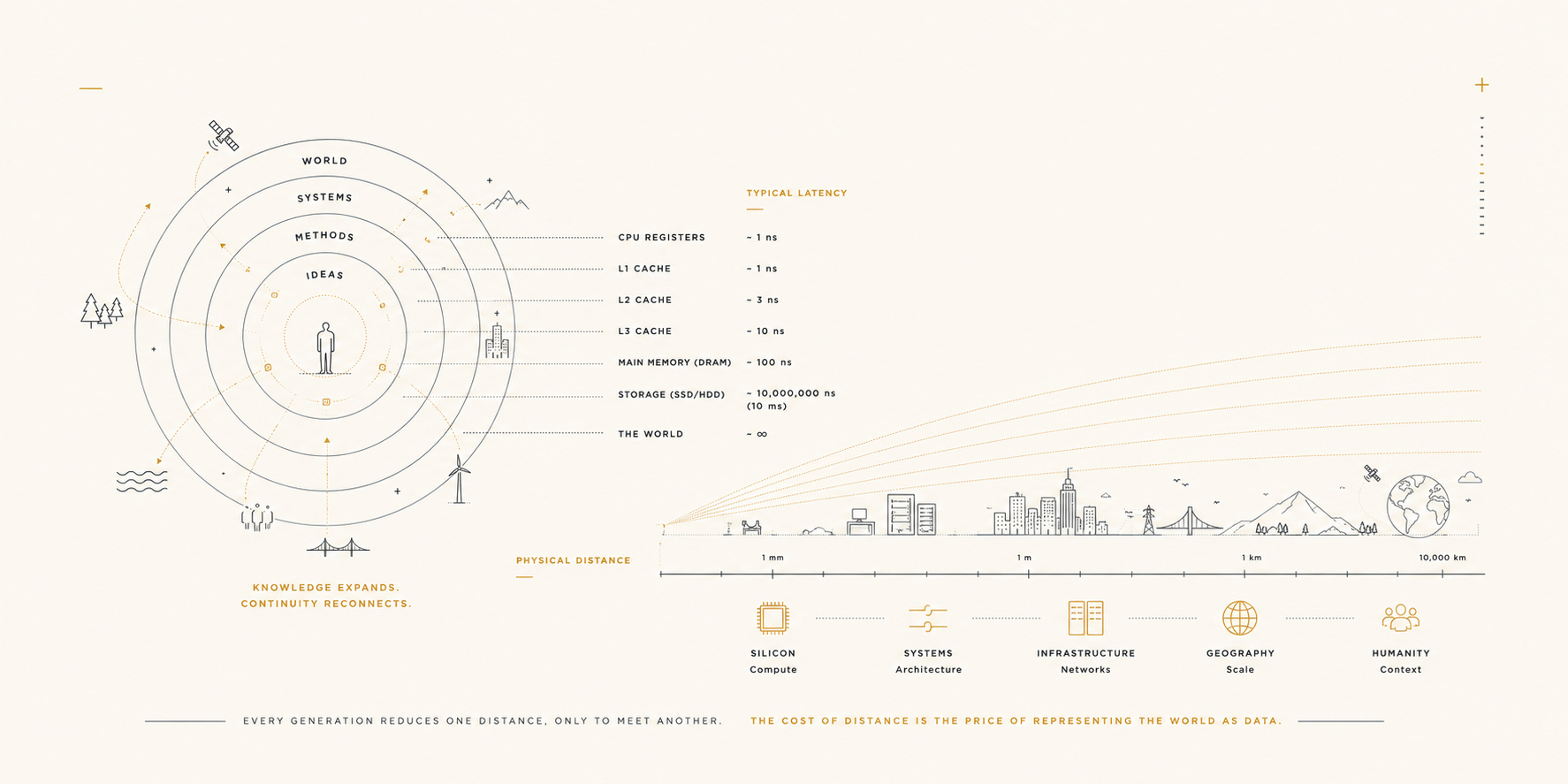
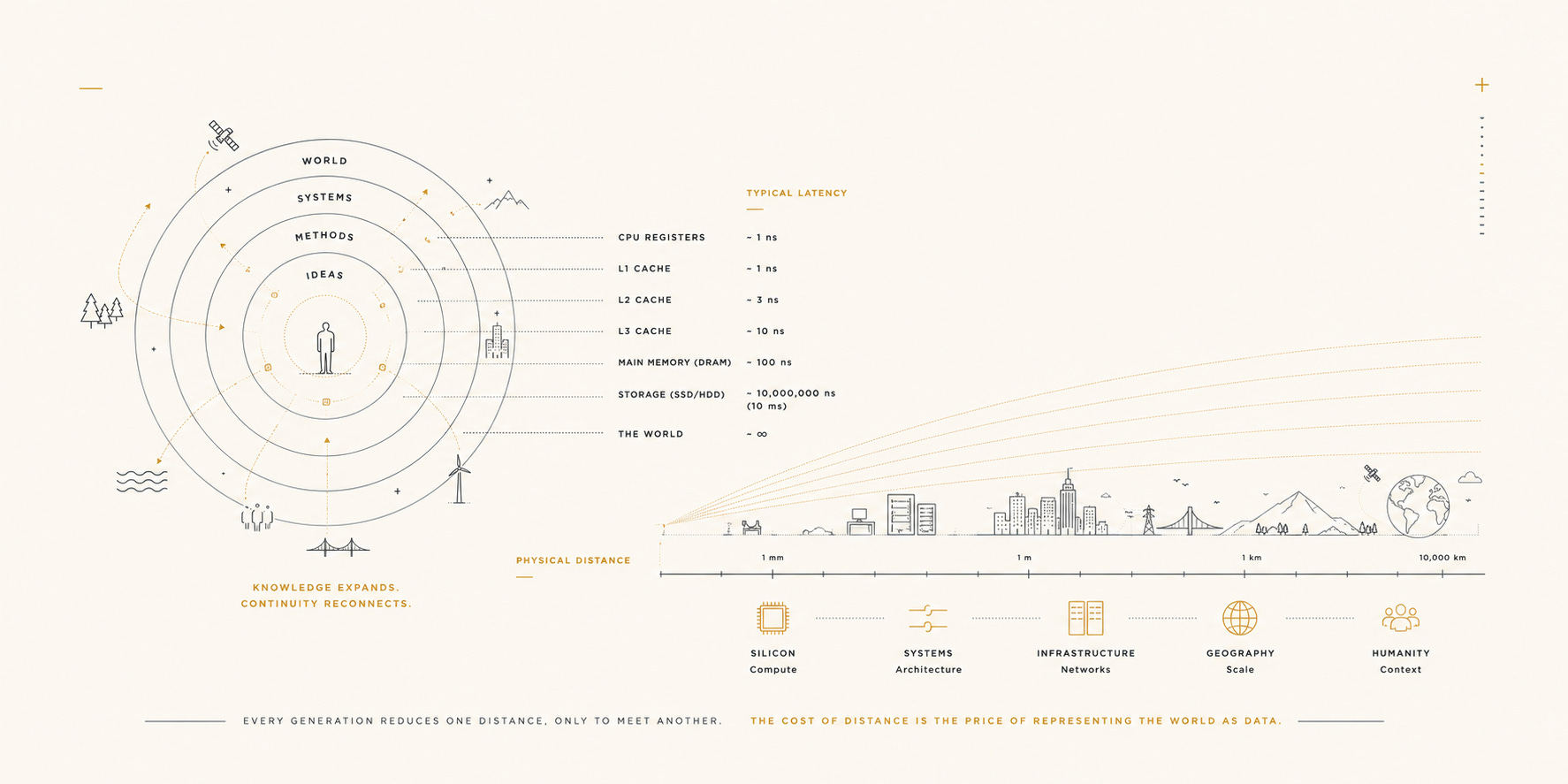
Let's use Geography as the microscope. Every real-world problem exists somewhere. It occupies space, unfolds across locations, and changes with scale. Therefore, distance and size shape how data and information are gathered and ultimately framed.
In the 21st century, computer systems modelling is the lens to represent these geographic phenomena independent of place and sometimes of scale, by projecting mathematical models as literal layers into computational frameworks.
With the saturated media spotlight of Artificial Intelligence (AI), one might be poised to imagine that these projections or representation challenges are long behind us. Yet, like every major shift in computing before it, AI has simply uncovered a new struggle for effective representation, whose enduring question remains: How do we move massive data efficiently through computational systems?
Advanced readers: Think compute-bound and memory-bound research.
This is the Cost of Distance: the persistent cost of representing the world as data and of efficiently representing it through computational systems, eventually becoming the hidden cost of scientific and technological innovation itself. It is the enduring constraint that every generation of computing has been forced to negotiate. As new architectures reduce one form of distance, another seemingly resolved bottleneck loosens, throwing us back into a spherical diverging wave with an even larger problem to tackle.
Each generation of computing has answered it differently.
Why now?
Most technology newsletters focus on breakthroughs. We will focus on the scientific struggles that produce them.
With a storytelling approach, we will aim to flatten the complex and seemingly impenetrable language of research into coherent mental models, helping you navigate an increasingly lexicon-heavy world of computing. More importantly, we will illuminate both along- and across-time conversations that seldom appear in published papers, such as the debates, trade-offs, failed assumptions, competing ideas, and evolving discourse that quietly shape the direction of research long before they become accepted knowledge. As a reader and active contributor, consider this a lab field notebook for computing, a blueprint for:
understanding the continuity of innovation,
how enduring constraints give rise to new architectures and systems,
why entire generations of researchers return to the same unresolved questions,
how today’s breakthroughs emerge from decades of negotiation rather than isolated moments of discovery.
More than summarizing papers, with weekly mini essays, we will:
Look beyond the technical moment to uncover enduring generational constraints. We will ask what friction keeps researchers, scientists and engineers returning to the exact same
implicitquestions across generations: What is the cost of distance—for effective technology?Give language to familiar patterns bridging the machine world and the physical map. We will articulate ideas across computing and geography using research podiums and databases, learning to close the knowledge continuity gap without forcing isolated disciplines into unnatural boxes.
Recover the arc of innovation by tracing volatile modern papers back to foundational histories. We will show how today’s systems, models, and technologies emerge from longer debates and historical memos of inquiry, rather than appearing as isolated breakthroughs.
Become smarter collaborators by replacing the frantic pressure to “keep up” with a calm, steady discipline. We will build a more coherent relationship with knowledge by understanding exactly where ideas come from, why they matter, and what remains unresolved.
In the end:
Our goal is to recover knowledge continuity so that research becomes easier to understand without losing its uncertainty. We want to experience research as it actually unfolds; unfinished, iterative, and often contested, while keeping sight of the deeper questions that give each discovery its place in a much larger story. By tracing those sometimes unspoken questions across generations, we hope to make sense not only of today's innovations, but of the enduring problems that continue to produce them.
All while connecting as an effective, grounded community attempting solutions to humanity’s uncovered troubles.
—Context_Researcher